
'This is an area where good lending can happen, and that is one of the priorities for the next quarter.'

The principal commissioner has been made responsible for developing and approving any intelligence, conducting search, and completing investigations and relevant subsequent actions, including at the lower field formations, points out T N C Rajagopalan.

The best course for the government at this time would be to tighten the seat belt a little more, without compromising on its investments in creating better infrastructure and giving a push to privatisation, points out A K Bhattacharya.

India's economy is expected to grow 6.4-6.7 per cent during the current financial year driven by strong domestic demand, even as geopolitical uncertainty poses downside risks, the newly appointed CII president Rajiv Memani said on Thursday.

Sources said that Langa and an unidentified employee of the Gujarat Maritime Board (GMB) have been booked on the charges of theft and under relevant sections of the Prevention of Corruption Act.
The fitment committee under the Goods and Services Tax (GST) Council, comprising central and state officials, has begun a rate rationalisation exercise afresh, checking the possibility of dropping some of the rates, particularly the 12 per cent slab, to achieve a revenue-neutral structure, a senior official with direct knowledge of the matter

At the stroke of midnight, live dashboards lit up simultaneously across Amazon India's World Trade Centre headquarters and Flipkart's Outer Ring Road office in Bengaluru. In sprawling "war rooms" at both the companies, executives monitored real-time data streams tracking payment speeds, inventory levels, and delivery logistics as millions of shoppers flooded online platforms.

From the Sensex firms, Tata Motors jumped the most by 5.54 per cent, followed by Kotak Mahindra Bank, Trent, Sun Pharma, Axis Bank, and ICICI Bank. However, Bajaj Finance, State Bank of India, UltraTech Cement and Tata Steel were among the laggards.
Despite a strong 7.8 per cent growth in the first quarter, the Indian economy is expected to grow at 6.5 per cent in the current financial year as the impact of US tariffs on Indian exports will reduce prospects, particularly in the second half, ADB said on Tuesday.

Parliamentary Standing Committee on Finance Chairman Yashwant Sinha wants the government to first introduce goods and services tax (GST) at the central level and set example for states to implement the indirect tax reform.
Can this growth in GST collection be sustained in the coming years? asks A K Bhattacharya.

The GST revenues for August 2023 have shown a growth of 11 per cent year on year due to increased compliance and less evasion, Revenue secretary Sanjay Malhotra said on Friday. The collection from Goods and Services Tax (GST) was Rs 1,43,612 crore in August 2022. "Roughly numbers are in the range of 11 per cent year on year growth as in earlier months," Malhotra told reporters.

Prime Minister Narendra Modi launched his Bihar assembly poll campaign, asserting that the NDA under Chief Minister Nitish Kumar will break all previous electoral records. He criticized the INDIA bloc and highlighted the NDA's cohesiveness and development efforts in Bihar.

While the economy will wait for a rate cut in December, the banking industry should be happy with the wave of liberalisation -- a big push for growth in bank credit, points out Tamal Bandyopadhyay.

The GST Council has set up a Group of Ministers, chaired by Haryana Deputy Chief Minister Dushyant Chautala, to suggest required changes in the law for setting up the GST Appellate Tribunal (GSTAT). The GST Council, chaired by Finance Minister Nirmala Sitharaman and comprising state ministers, had last week decided to constitute a Group of Ministers (GoM) to address various concerns raised by states in relation to constitution of the GSTAT. As per the Terms of Reference (ToR) of the GoM, the panel would recommend required amendments in the GST law to ensure that the legal provisions maintain the right federal balance and are in line with the overall objective of uniform taxation within the country.
'There are unscrupulous traders who create fake invoices by showing bogus e-way bills, movement of goods.' 'Since the entities registered across different states, and kept on changing their numbers, tracing them was difficult.'

Jan Suraaj Party founder Prashant Kishor alleges Bihar Deputy Chief Minister Samrat Choudhary escaped a murder trial by falsely claiming to be a minor. He demands Choudhary's dismissal and threatens to expose further financial irregularities.

The government is working to make India's automobile industry number one in the world within five years, Union Minister Nitin Gadkari said on Monday. Inaugurating the 'International Value Summit 2025', Gadkari said the automobile sector pays maximum GST revenue to the government and generates employment opportunities.
GST collections in March grew 13 per cent to the second highest ever at Rs 1.60 lakh crore, taking the growth rate of revenue mop-up for full 2022-23 fiscal to 22 per cent. March also saw over 91 per cent of the GST registered businesses filing returns and paying taxes - reflecting greater compliance and improving economic activity. Gross GST revenue collected in March 2023 is Rs 1,60,122 crore, of which Central GST is Rs 29,546 crore, State GST is Rs 37,314 crore, Integrated GST is Rs 82,907 crore (including Rs 42,503 crore collected on import of goods) and cess is Rs 10,355 crore, the finance ministry said in a statement.

: Build lasting wealth via disciplined, long-term mutual fund investing in India's compounding marathon, Shanaihi, Shanaihi, says Ramalingam Kalirajan

Jailed journalist Mahesh Langa, already facing multiple charges, has been booked in a fresh case for allegedly extorting Rs 40 lakh from a real estate agent by threatening to malign his image and implicate him in a false case. This is the fifth FIR registered against him since his arrest in October 2023 for an alleged Goods and Services Tax (GST) scam. The latest case was registered based on a complaint by Janak Thakor, a real estate agent, who alleged that Langa threatened to write negative articles about him and trap him in a false case unless he paid the money. Langa has been in jail since his arrest in October and is facing charges in four previous cases registered by Ahmedabad, Gandhinagar, and Rajkot police.

The Centre has recovered around Rs 95.86 crore from at least 11 crypto exchanges for evading goods and services tax (GST), according to data released by Parliament on Monday. The amount includes interest and penalty. The GST investigation department has detected a total tax evasion of Rs 81.54 crore by crypto exchanges that include WazirX, Coin DCX, CoinSwitch Kuber, Buy Ucoin, UnoCoin and Flitpay, among other exchanges. In a written reply to Lok Sabha, minister of state (MoS) for finance Pankaj Chaudhary said 11 cases of GST evasion by cryptocurrency exchanges have been detected by central GST formations.
One of the grey areas is whether the anti-profiteering provisions can provide for a comparison of tax rates between the pre-GST and post-GST eras, says Niraj Bagri.
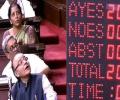
Enthused by the consensus in reaching four-tiered GST tax structure, particularly the unanimity achieved with Congress-ruled states, senior government sources were confident that the Central GST and Integrated GST Bills will be passed by both the Houses.

Patanjali Foods has been served a show cause notice by the GST intelligence department, asking the company to explain why input tax credit worth Rs 27.46 crore should not be recovered from it. The yoga guru Ramdev-led Patanjali Ayurved Group firm, which is mainly into the edible oil business, has received the notice from the Directorate General of GST Intelligence, Chandigarh Zonal Unit, according to a regulatory filing made by the company on April 26.

GST revenue remained above Rs 1 lakh crore for the second straight month in August at over Rs 1.12 lakh crore, 30 per cent higher than the collection in the year-ago period, the finance ministry said on Wednesday. "The gross GST revenue collected in the month of August 2021 is Rs 1,12,020 crore of which Central GST is Rs 20,522 crore, State GST is Rs 26,605 crore, Integrated GST is Rs 56,247 crore (including Rs 26,884 crore collected on import of goods) and Cess is Rs 8,646 crore (including Rs 646 crore collected on import of goods)," the finance ministry said in a statement. The mop up in August is, however, lower than Rs 1.16 lakh crore collected in July 2021.

Only after its recommendations will the central GST, integrated GST and state GST Bills be taken up

Goods and Services Tax (GST) collections at Rs 95,480 crore in September touched the highest level so far this fiscal, the finance ministry said on Thursday.

The total gross GST revenue collected in the month of June, 2019 is Rs 99,939 crore

A discussion paper by the empowered committee of state finance minister released today said taxes levied by the central government like excise, additional excise duty and various surcharges and cesses would be part of the GST.

GST authorities have issued show cause notices worth Rs 1 lakh crore to online gaming companies for tax evasion so far, a senior official said on Wednesday. The official, however, said there is no data yet of foreign gaming companies registering in India since October 1. The government has amended the GST law, making it mandatory for overseas online gaming companies to register in India from October 1.

Revenue from Goods and Services Tax (GST) stood at over Rs 1.04 lakh crore in November as against Rs 1.05 lakh crore collected in the previous month, the Finance Ministry said in a statement. This is the second straight month in the current fiscal when GST revenue has topped Rs 1 lakh crore. The collection in November 2020 is 1.4 per cent higher than in November 2019 when the GST mop-up was Rs 103,491 crore.

From 2010 onwards, states will get power to levy and collect the dual goods and service tax (GST) on certain services like amusement parks, private health and education services.
The change in the peak rate will not alter the 4-slab rate structure of 5, 12, 18 and 28 per cent agreed upon last year, but is only a provision being built into the model law to take care of contingencies in future, two officials in the know told PTI.

In signs of acceleration in economic activity, India's tax collections on goods sold and services rendered returned to over Rs 1 lakh crore in July after the second wave of Covid-related restrictions caused a blip in the previous month. Goods and Services Tax (GST) mop-up grew 33 per cent year-on-year in July to over Rs 1.16 lakh crore, indicating that the economy is recovering at a fast pace. In July 2020, the collection was Rs 87,422 crore. This is the second highest collection so far this fiscal after a record Rs 1.41 lakh crore mop-up in April.

Facing a deepening slowdown, the auto sector is pinning hopes on the GST Council meeting on September 20 for a rate cut from 28 per cent to 18 per cent. However, states including Bihar, West Bengal, Kerala, and Punjab are of the view that the slowdown in the auto sector is not because of the GST rate but structural issues in the economy.
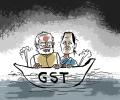
CAG recommended fixing a definite time frame for rolling out simplified GST return forms.

Is the curated and limited data put out by the central government sufficient enough to pass a judgement on the trend in GST collections, particularly that of the Centre?

The textile and apparel sector is India's second-largest employment provider, after agriculture, and it is now caught in a wave of uncertainty following the Donald Trump administration's tariff policy.

Businesses that have not filed GSTR-3B returns in the preceding two months will not be able to file details of outward supplies in GSTR-1 from September 1, GSTN has said. While businesses file GSTR-1 of a particular month by the 11th day of the subsequent month, GSTR-3B, through which businesses pay taxes, is filed in a staggered manner between 20th-24th day of the succeeding month. In an advisory to taxpayers, GSTN, which manages the technology backbone for Goods and Services Tax, said that Rule-59(6) of Central GST Rules which provides for restriction in filing of GSTR-1, will come into effect from September 1, 2021.
